Matter, Agency and Design: Toward a Relational Ontology of Biomaterials
DOI:
https://doi.org/10.46516/inmaterial.v10.329Keywords:
biomaterials, waste, algae, agential realism, designAbstract
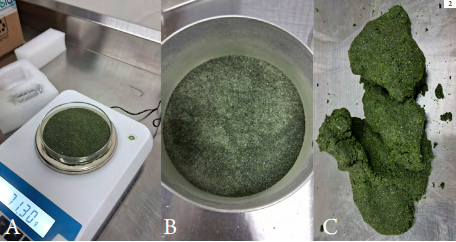
This paper proposes a new approach to design and architecture through the use of algae-based biomaterials, framed within ecological post-humanism and agential realism. In the context of the climate crisis, it advocates for an ethics of design that acknowledges matter’s agency and promotes collaborative relationships between humans, materials and the environment. Drawing on the theories of Barad, Bennett and Haraway, materiality is reinterpreted as an intra-active phenomenon where algae are not mere resources but living entities with the capacity to affect and be affected. The research explores Do-It-Yourself (DIY) materials from the vegetabile and recuperavit realms, focusing on algae such as Ulva, collected on the coast of Algarrobo, Chile. Using low-tech fabrication methods, a bio-based panel was developed and tested for its thermal, water and fire resistance properties. The study highlights the potential of these biomaterials to replace industrial components, offering a sustainable and ecological alternative.
Moreover, the work emphasises the role of female seaweed gatherers as key agents in a collaborative, circular economy, valuing local knowledge and community-based co-creation. The project envisions an aesthetic and ethical design process where matter and designer co-evolve through dynamic and relational practices. The resulting prototype demonstrates that it is possible to design materials with a life of their own, capable of responding to environmental stimuli, dissolving the nature/culture divide, and fostering a more equitable, sustainable, and territorially grounded model of development.
Downloads
References
-Alvear, F. (2024). El rol de la mujer en la pesca artesanal. Biblioteca del Congreso Nacional de Chile 87(4).
-Anderson, C. (2012). Maker: The New Industrial Revolution. Crown Business.
-Ascuntar-Rivera, M. C., Valbuena-Buitrago, W. S. y Ayala-Gallardo, F. R. (2022). Materiales Do It Yourself DiY: exploraciones emergentes sobre las cualidades expresivo-sensorio-emocionales. Arte, Individuo y Sociedad, 35(1), 139-156. https://doi.org/10.5209/aris.81187
-Ashby, M. y Johnson, K. (2013). Materials and design: the art and science of material selection in product design. Elsevier.
-Barad, K. (2007). Meeting the universe halfway: Quantum physics and the entanglement of matter and meaning. Duke University Press. https://doi.org/https://doi.org/10.1215/9780822388128
-Barad, K. (2017). Troubling time/s and ecologies of nothingness: Re-turning, re-membering, and facing the incalculable. New formations. Journal of Culture/Theory/Politics, 92, 56-86. https://doi.org/https://doi.org/10.3898/NEWF:92.05.2017
-Bennett, J. (2004). The force of things: Steps toward an ecology of matter. Political Theory, 32(3), 347-372. https://doi.org/10.1177/0090591703260853
-Bennett, J. (2010). Vibrant matter: A political ecology of things. Duke University Press. https://doi.org/https://doi.org/10.1215/9780822391623
-Boulton, E. (2016). Climate change as a ‘hyperobject’: a critical review of Timothy Morton’s reframing narrative. WIREs Clim Change, 7, 772-785. https://doi.org/https://doi.org/10.1002/wcc.410
-Braidotti, R. (2013). The Posthuman. Polity Press.
-Diario El Regional. (2025, 11 de noviembre). Inician proyecto impulsado por municipio que permite recolección de algas de antes que varen en playa La Herradura. Diario El Regional. http://www.diarioregional.cl/notaene2413d.html
-Donoso, S., Wechsler, A. (2020). Los materiales bio basados y el paradigma desarrollista latinoamericano: perspectivas desde el diseño industrial. Cuadernos del Centro de Estudios en Diseño y Comunicación (114). https://doi.org/10.18682/cdc.vi114.4116
-Duarte, S., Romani, A. y Rognoli, V. (2024). Emerging materials for transition: A taxonomy proposal from a design perspective. Sustainable Futures. https://doi.org/10.1016/j.sftr.2024.100155
-Ertz, M. (2024). Co-Creation. Encyclopedia, 4(1), 137-147. https://doi.org/https://doi.org/10.3390/encyclopedia4010012
-Fenoglio, V. (2024). Hacia una bioeconomía circular, regenerativa y nuevas formas de producción. Estudio de caso: Proyecto Siempremonte, Provincia de Córdoba, Argentina. Hábitat y Sociedad, (17), 241-262. https://doi.org/10.12795/HabitatySociedad.2024.i17.11
-Gallardo-Fernández, G. L. y Saunders, F. (2018). «Before we asked for permission, now we only give notice»: Women’s entrance into artisanal fisheries in Chile. Maritime Studies, 17(2), 177-188. https://doi.org/10.1007/s40152-018-0110-z
-Gershenfeld, N. (2012). How to make almost anything the digital fabrication revolution. Foreign Affairs, 91(6), 43-57. http://www.jstor.org/stable/41720933
-Grindell, C., Coates, E., Croot, L. y O’Cathain, A. (2022). The use of co-production, co-design and co-creation to mobilise knowledge in the management of health conditions: a systematic review. BMC Health Services Research, 22(1), 1-26. https://doi.org/10.1186/s12913-022-08079-y
-Haraway, D. (1995). Ciencia, cyborgs y mujeres. La reinvención de la naturaleza. (Cátedra). Universitat Politècnica de València.
-Haraway, D. (2006). A cyborg manifesto: Science, technology, and socialist-feminism in the late 20th Century. En The International Handbook of Virtual Learning Environments (pp. 117-158). Springer. https://doi.org/https://doi.org/10.1007/978-1-4020-3803-7_4
-Haraway, D. (2016). Staying with the trouble: Making kin in the Chthulucene. Duke University Press.
-Iglesias, A. (2025). Fenómenos y sistemas simpoiéticos: naturaleza y gráfica (de campo expandido). Aniav - Revista de Investigación en Artes Visuales, 16, 31-46. https://doi.org/https://doi.org/10.4995/aniav.2025.21304
-Karana, E. (2009). Meanings of materials. Technical University Delft.
-Karana, E., Barati, B., Rognoli, V. y Laan, A. Z. Van Der. (2015). Material Driven Design (MDD): A method to design for material experiences. International Journal of Design, 9(2), 35-54.
-Khan, S., Soomro, S. A., Rajaden, D. y Georgiev, G. V. (2023). Co-creation through digital fabrication technology: A systematic literature review. IASDR 2023: Life-Changing Design. https://doi.org/10.21606/iasdr.2023.250
-Kuqo, A. y Mai, C. (2022). Hojas de pastos marinos: un recurso alternativo para la producción de materiales aislantes. Materials, 15(19), 6933. https://doi.org/10.3390/ma15196933
-Kuqo, A., Korpa, A. y Dhamo, N. (2019). Posidonia oceanica leaves for processing of PMDI composite boards. Journal of Composite Materials, 53(12), 1697-1703. https://doi.org/10.1177/0021998318808024
-Kusumastuti, R., Silalahi, M. y Sambodo, M. (2023). Understanding rural context in the social innovation knowledge structure and its sector implementations. Management Review Quarterly, 73, 1873-1901. https://doi.org/https://doi.org/10.1007/s11301-022-00288-3
-Laurenti, R., Singh, J., Cotrim, J. M., Toni, M. y Sinha, R. (2019). Characterizing the sharing economy state of the research: A systematic map. Sustainability (Switzerland), 11(20), 1-21. https://doi.org/10.3390/su11205729
-Lefèvre Martín, Naia (2024). Piñatex, el sustituto sostenible del cuero. GDI. Revista de investigación de Género, Diseño e Innovación, (1), 1-10. https://doi.org/10.63206/GDI-2024-1
-Lessig, L. (2008). Making art and commerce thrive in the hybrid economy. Bloomsbury Academic.
-Liu, Y., Gao, W. y Wang, X. (2023). Research on the history, ecology, and design of folk houses: A review of the literature on seaweed houses in China. Journal of Asian Architecture and Building Engineering, 22(6), 3414-3434. https://doi.org/10.1080/13467581.2023.2213293
-Marchesi, M. y Tweed, C. (2021). Social innovation for a circular economy in social housing. Sustainable Cities and Society, 71, 102925. https://doi.org/10.1016/J.SCS.2021.102925
-Milesi, O. (2024). Chilean fisherwomen seek visibility and escape from vulnerability. Inter Press Service. https://www.globalissues.org/news/2024/08/05/37380
-Morton, J. y O’Brien, D. (2005). Selling your design: Oral communication pedagogy in design education. Communication Education, 54(1), 6-19. https://doi.org/10.1080/03634520500076885
-Morton, T. (2013). Hyperobjects: Philosophy and ecology after the end of the world. University of Minnesota Press.
-Mutizabal-Aros, J., Ramírez, M. E., Haye, P. A., Meynard, A., Pinilla-Rojas, B., Núñez, A., Latorre-Padilla, N., Search, F. V., Tapia, F. J., Saldías, G. S., Navarrete, S. A. y Contreras-Porcia, L. (2024). Morphological and molecular identification of Ulva spp. (Ulvophyceae; Chlorophyta) from Algarrobo Bay, Chile: Understanding the composition of green tides. Plants, 13(9), 1258. https://doi.org/10.3390/plants13091258
-Nakhate, P. y van der Meer, Y. (2021). A systematic review on seaweed functionality: A sustainable bio-based material. Sustainability (Switzerland), 13(11), 6174. https://doi.org/10.3390/su13116174
-Navarrete, S. A., Martínez, C., Troncoso, W. y Tapia, F. J. (2024). Mareas verdes en la Bahía de Algarrobo: Conocimiento ecológico y oceanográfico para informar sobre sus causas y potenciales medidas de mitigación.
-Ochoa Rojas, L. (2025). Realismo Agencial de Karen Barad.
-Ohnishi, S., Osako, M., Nakamura, S., Togawa, T., Kawai, K., Suzuki, K., Yoshida, A., Gomi, K. y Tsuji, T. (2024). A framework for analyzing co-creation value chain mechanisms in community-based approaches: A literature review. Sustainability (Switzerland), 16(7), 2919. https://doi.org/10.3390/su16072919
-ONU. (2019). Informe de los Objetivos del Desarrollo Sostenible 2019, 64.
-Otero, A. (2022). Cocinas, residuos e impresión 3D. Biomateriales basados en cáscaras de huevo y conchas de mejillón. Inmaterial, 7(13), 55-74. https://doi.org/10.46516/inmaterial.v7.145
-Oyarzo-Miranda, C., Otaíza, R., Bellorín, A., Vega, J. M. A., Tala, F., Lagos, N. A., Oyarzún, F. X., Estévez, R. A., Latorre-Padilla, N., Mora Tapia, A. M., Figueroa-Fábrega, L., Jara-Yáñez, R., Bulboa, C. y Contreras-Porcia, L. (2023). Seaweed restocking along the Chilean coast: History, present, and inspiring recommendations for sustainability. Frontiers in Marine Science, 9(January), 1-22. https://doi.org/10.3389/fmars.2022.1062481
-Parisi, S., Rognoli, V. y Ayala-Garcia, C. (2016). Designing materials experiences through passing of time - Material driven design method applied to mycelium-based composites. Proceedings - D and E 2016: 10th International Conference on Design and Emotion - Celebration and Contemplation, March 2020, 239–255.
-Parisi, S., Rognoli, V. y Sonneveld, M. (2017). Material tinkering. An inspirational approach for experiential learning and envisioning in product design education. Design Journal, 20(sup1), S1167–S1184. https://doi.org/10.1080/14606925.2017.1353059
-Rammou, E., Mitani, A., Ntalos, G., Koutsianitis, D., Taghiyari, H. R. y Papadopoulos, A. N. (2021). The potential use of seaweed (posidonia oceanica) as an alternative lignocellulosic raw material for wood composites manufacture. Coatings, 11(1), 1-9. https://doi.org/10.3390/coatings11010069
-Rodríguez-Martínez, R. E., Jordán-Dahlgren, E. y Hu, C. (2022). Spatio-temporal variability of pelagic Sargassum landings on the northern Mexican Caribbean. Remote Sensing Applications: Society and Environment, 27, 100767. https://doi.org/10.1016/J.RSASE.2022.100767
-Rognoli, V. y Ayala, C. (2018). Materia emocional. Los materiales en nuestra relación emocional con los objetos. RChD: Creación y Pensamiento, 3(4), 1-15. https://doi.org/10.5354/0719-837x.2018.50297
-Rojas, C., Rodríguez, K., Cárdenas, J. P., (2023). Evaluation of two Chilean native macroalgae: «Pelillo» (Gracilaria Chilensis) and «Lamilla» (Ulva sp.) for thermal insulation application. Buildings, 13(10), 2322. https://doi.org/10.3390/buildings13102622
-Rossignolo, J. A., Felicio Peres Duran, A. J., Bueno, C., Martinelli Filho, J. E., Savastano Junior, H. y Tonin, F. G. (2022). Algae application in civil construction: A review with focus on the potential uses of the pelagic Sargassum spp. biomass. Journal of Environmental Management, 303(December 2021), 114258. https://doi.org/10.1016/j.jenvman.2021.114258
-Rouse, J. (2004). Barad’s feminist naturalism. Hypatia, 19(1), 142-161. https://doi.org/10.1111/j.1527-2001.2004.tb01272.x
-Sanches, P., Howell, N., Tsaknaki, V., Jenkins, T. y Helms, K. (2022). Diffraction-in-action: Designerly explorations of agential realism through lived data. Conference on Human Factors in Computing Systems - Proceedings. https://doi.org/10.1145/3491102.3502029
-Sauerwein, M., Karana, E. y Rognoli, V. (2017). Revived beauty: Research into aesthetic appreciation of materials to valorise materials from waste. Sustainability (Switzerland), 9(4), 529. https://doi.org/https://doi.org/10.3390/su9040529
-Sernapesca. (2023). Mujeres y hombres en el sector pesquero y acuicultor de Chile 2023. https://www.sernapesca.cl/app/uploads/2024/03/Mujeres-y-Hombres-en-el-sector-pesq-y-acui-2023.pdf
-Soomro, S., Casakin, H. y Georgiev, G. (2021). Sustainable design and prototyping using digital fabrication tools for education. Sustainability, 13(3), 1196; https://doi.org/10.3390/su13031196
-Talibi, S., Page, J., Djelal, C. y Saâdi, L. (2024). Impact of treated red-algae fibers on physico-mechanical behavior of compressed earth bricks for construction. European Journal of Environmental and Civil Engineering, 28(12), 2914-2947. https://doi.org/10.1080/19648189.2024.2329722
-Ullmann, J. y Grimm, D. (2021). Algae and their potential for a future bioeconomy, landless food production, and the socio-economic impact of an algae industry. Organic Agriculture, 11(2), 261-267. https://doi.org/10.1007/s13165-020-00337-9
-Universidad de Chile. (2023). «Hierbas de mar»: Proyecto del Fondo Valentín Letelier realizó taller sobre innovación tecnológica con algas. https://uchile.cl/noticias/207234/proyecto-hierbas-de-mar-realizo-taller-de-innovacion-con-algas
-Valenzuela-Zubiaur, M., Bustos, H. T., Arroyo-Vázquez, M., y Ferrer-Gisbert, P. (2021). Promotion of social innovation through Fab Labs. The case of Proteinlab UTEM in Chile. Sustainability (Switzerland), 13(16), 8790. https://doi.org/10.3390/su13168790
-Van Kesteren, I. E. H., Stappers, P. J. y Kandachar, P. V. (2005). Representing product personality in relation to materials in the design problem. International Conference of the Nordic Design Research Society, 29-31.
-Vempada, S., Nayeem, M., Saduwale, S., Rao, M.V. (2025). Bio-inspired Self - Healing Concrete using Algae - Based healing Agents for Crack Repair. En B. S. Babu et al. (eds.), Proceedings of International Conference on Advanced Materials, Manufacturing and Sustainable Development (ICAMMSD-2024). Advances in Engineering Research, 257, https://doi.org/10.2991/978-94-6463-662-8_78
-Vezzoli, C. (2018). Design for Environmental Sustainability. Springer. https://doi.org/https://doi.org/10.1007/978-1-4471-7364-9
-Wang, M., Hu, C., Barnes, B., Mitchum, G., Lapointe, B. y Montoya, J. (2019). The great Atlantic Sargassum belt. Science, 365(6448), 83-87. https://doi.org/10.1126/science.aaw7912
-Webb, S. (2021). Why agential realism matters to social work. The British Journal of Social Work, 51(8), 2964-2981. https://doi.org/https://doi.org/10.1093/bjsw/bcaa106
-Wolaniuk, L. (2023). La realidad como intra-actividad: implicancias post-metafísicas del Realismo Agencial de Karen Barad. Actas AFRA 2023: Congreso Nacional de Filosofía.
-Zannen, S., Halimi, M. T., Hassen, M. Ben, Abualsauod, E. H. y Othman, A. M. (2022). Development of a multifunctional wet laid nonwoven from marine waste Posidonia oceanica technical fiber and CMC binder. Polymers, 14(5), 865. https://doi.org/10.3390/polym14050865
-Zhang, T. C., Jahromi, M. F. y Kizildag, M. (2018). Value co-creation in a sharing economy: The end of price wars? International Journal of Hospitality Management, 71, 51-58. https://doi.org/10.1016/J.IJHM.2017.11.010
Published
How to Cite
Issue
Section
License
Copyright (c) 2025 Suzanne Segeur Villanueva , Macarena Valenzuela-Zubiaur , Héctor Torres Bustos , Luis Palmero

This work is licensed under a Creative Commons Attribution-ShareAlike 4.0 International License.