Towards a Biomaterial Transformation: Tensions and contradictions in co-creation with fungi, bacteria and algae in regenerative design
DOI:
https://doi.org/10.46516/inmaterial.v11.305Keywords:
Biomaterials, multispecies co-creation, material ecologies, regenerative design, material agencyAbstract
This article examines how practices of co-creation with living organisms can contribute to the construction of more regenerative presents and futures. The guiding question of the text is: what methodological, material and logistical conditions enable (or hinder) a biomaterial-based design aligned with ecological cycles, and what contradictions emerge when these practices are translated into contemporary professional and institutional contexts?
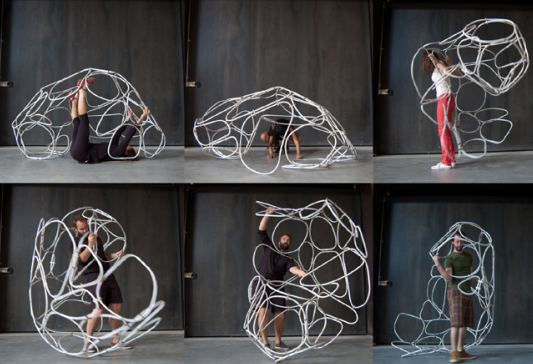
The contribution is articulated as a critical reflection based on a narrative review of international references and on the analysis of prototypes and case studies developed by this research team, situated within an expanded understanding of design. To this end, the article traces a trajectory from generative algorithms inspired by natural geometries to design processes that incorporate living materials and adaptive architectures, assuming the impossibility of absolute control and the need to acknowledge the co-agentiality of fungi, bacteria and algae.
The analysed cases reveal recurring tensions between the ideal of material circularity and real production conditions: the unavoidable use of plastics (moulds and packaging), reliance on international transportation, and constraints imposed by cultural circuits such as biennials and exhibitions. As contributions, the article proposes: (1) material traceability as a critical and pedagogical tool for evaluating decisions and commitments, (2) a design approach that prioritises careful relationships between materials, bodies, and environments and (3) transferable analytical criteria for integrating living material processes into phases of prototyping, documentation and public mediation. Finally, the article highlights the articulation between experimental research, academia and applied practice as a key condition for sustaining these approaches in real-world contexts.
Downloads
References
-Barad, K. (2007). Meeting the universe halfway: Quantum physics and the entanglement of matter and meaning. Duke University Press.
-Braidotti, R. (2022). Lo posthumano. Gedisa.
-Elhacham, E., Ben-Uri, L., Grozovski, J., Bar-On, Y. M. y Milo, R. (2020). Global human-made mass exceeds all living biomass. Nature, 588, 442-444. https://doi.org/10.1038/d41586-020-03484-3
-Estévez, A. (s. f.). Biodigital Architecture & Genetics. Biodigital Architecture Master’s Program. http://www.biodigitalarchitecture.com/
-Fallan, K. y Halland, I. (2023). Material Ecologies of Design. Routledge.
-Frazer, J. (1995). An Evolutionary Architecture. Architectural Association
-Gálvez, M. A. (2019). Espacio somático: Cuerpos múltiples. Ediciones Asimétricas.
-Giaccardi, E. y Karana, E. (2015). Foundations of materials experience: An approach for HCI. Proceedings of the 33rd Annual ACM Conference on Human Factors in Computing Systems, 2447-2456.
-Gil-Fournier, M. (2022). Las casas que me habitan. Editorial Arquitecturas Afectivas.
-Haraway, D. J. (2019). Seguir con el problema: Generar parentesco en el Chthuluceno. Consonni.
-Herrero, Y. (2021). Los cinco elementos. Arcadia.
-Karana, E., Barati, B., Rognoli, V. y Zeeuw van der Laan, A. (2015). Material Driven Design (MDD): A method to design for material experiences. International Journal of Design, 9(2), 35-54.
-Karana, E., Pedgley, O. y Rognoli, V. (2013). Materials experience as a foundation for materials and design education. International Journal of Design, 7(2), 1-17.
-Karana, E., Pedgley, O. y Rognoli, V. (2015). On Materials Experience: Design-Driven Research on Materials in Products. Butterworth-Heinemann.
-Mallo, M. (2013). Natural Patterns and Complex Architectures. First International Conference Transformables (pp. 257-262). Universidad de Sevilla.
-Mallo, M. (2015). Sistemas Radiolarios, geometrías y arquitecturas derivadas (Tesis doctoral, ETSAM, UPM).
-Mallo, M., Vidal, M. y Santamaría, J. (2014). Efficient Irregular Tessellation. Biodigital Architecture & Genetics (pp. 374-384). Universidad Internacional de Cataluña (UIC) y ETSARQ.
-Margulis, L. (2002). Planeta simbiótico: Un nuevo punto de vista sobre la evolución. Debate.
-Morton, T. (2018). El pensamiento ecológico. Interzona.
-Novak, M. (1991). Liquid architectures in cyberspace en M. Benedikt (Ed.), Cyberspace: First Steps. MIT Press.
-Oxman, N. (2020). One Material. One Biome. Mediated Matter Group. https://matter.media.mit.edu/projects/one-material-one-biome
-Oxman, N. et al. (2012). Silk Pavilion. Mediated Matter Group, MIT Media Lab. https://www.media.mit.edu/projects/silk-pavilion/overview/
-Parikka, J. (2015). A Geology of Media. University of Minnesota Press.
-Pizarro, E. y Rego, M. Á. (2025). Metodología EcoMat: creación artística de materiales emergentes biobasados (MEB). Inmaterial. Diseño, Arte y Sociedad, 10(20), 56-77. https://doi.org/10.46516/inmaterial.v10.322
-Pizarro, E., Trigo, M. y Marcos, I. (Eds.) (2025a). EcoMat: Ecología material. Archivo de materiales emergentes biobasados. Asociación EcoHabitar para una Cultura Regenerativa.
-Pizarro, E., Trigo, M. y Marcos, I. (Eds.) (2025b). EcoMat: Ecología material. Manual práctico de materiales emergentes biobasados. Asociación EcoHabitar para una Cultura Regenerativa.
Published
How to Cite
Issue
Section
License
Copyright (c) 2026 María Mallo Zurdo

This work is licensed under a Creative Commons Attribution-ShareAlike 4.0 International License.