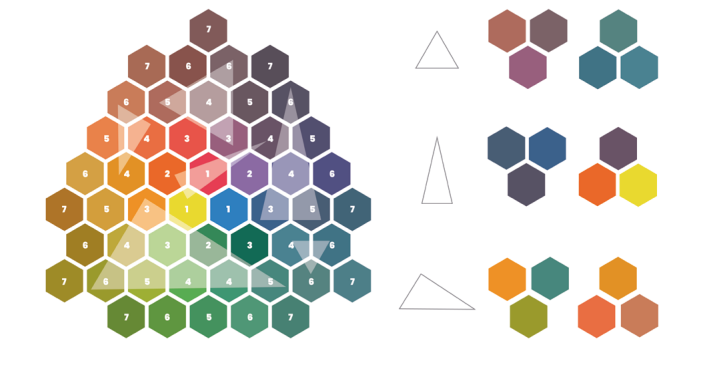
The Chromatic Honeycomb: A decolonial and relational approach to rethinking colour from matter
DOI:
https://doi.org/10.46516/inmaterial.v11.286Keywords:
Archeochromatic, Colour schemes, Decolonial, Design methodology, Cultural referencesAbstract
This article proposes an approach to reinterpreting colour based on matter, territory and experimentation, in the context of a persistent colonial memory in visual systems. The ‘chromatic honeycomb model’ was developed with the aim of establishing a structure distinct from the traditional colour wheel. The model expands chromatic relationships at the quaternary, quinary, senary and septenary levels, articulating material, emotional and cultural interaction. The study articulates analogue mixing tests, chromatic sampling and digitisation of visual references from Tikuna, Emberá Katío and Guane contexts. Through digital experimentation and exploratory pedagogical validation with 90 graphic design students and analytical contrast with artists and teachers of visual arts, a non-extractive and relational ecology of colour is proposed.
The article engages with contemporary debates on colour theory, materiality, visual coloniality and modern design critique, proposing a reflection situated from the South on the relationships between nature and culture, technology and situated knowledge.
Downloads
References
-Barad, K. (2007). Meeting the universe halfway: Quantum physics and the entanglement of matter and meaning. Duke University Press.
-Barriendos, J. (2011). La colonialidad del ver: Hacia un nuevo diálogo visual interepistémico. Revista Nómadas, (35), 13-29. https://www.redalyc.org/articulo.oa?id=105122653002
-Camps, M. (2021). Saber en la acción: Prácticas pedagógicas indisciplinadas. Universitat de Barcelona.
-Castro-Gómez, S. (2007). Michel Foucault y la colonialidad del poder. Tabula Rasa, (6), 153-172. http://www.redalyc.org/articulo.oa?id=39600607
-González, A. M. (2022). Arqueocromática y color ritual en contextos arqueológicos. Revista de Arqueología Americana, (60), 47-68.
-Haraway, D. (1988). Situated Knowledges: The Science Question in Feminism and the Privilege of Partial Perspective. Feminist Studies, 14(3), 575-599. https://doi.org/10.2307/3178066
-Itten, J. (1970). The Elements of Color. John Wiley & Sons
-Mignolo, W. D. (2007). La idea de América Latina. Gedisa.
-Museo del Oro y UCL Institute of Archaeology (2013). Historias de ofrendas muiscas. Banco de la República.
-Munsell, A. H. (1905). A Color Notation. G. H. Ellis Co.
-Newton, I. (1704). Opticks: Or, a Treatise of the Reflexions, Refractions, Inflexions and Colours of Light. Sam. Smith and Benj. Walford.
-Puig de la Bellacasa, M. (2017). Matters of Care. University of Minnesota Press.
-Quijano, A. (2000). Colonialidad del poder, eurocentrismo y América Latina en E. Lander (Ed.), La colonialidad del saber (pp. 201-246). CLACSO.
-Rivera Cusicanqui, S. (2015). Sociología de la imagen. Tinta Limón.
-Rufer, M. (2016). Pensar la subalternidad en nuestros días. Revista Versión, (37), 7-12.
-Segato, R. (2017). Descolonialidad: Una imagen del pensamiento. Orilleras, (2).
-Von Goethe, J. W. (1810). Zur Farbenlehre. Cotta.
-Walsh, C. (2005). Interculturalidad, Estado, sociedad. Universidad Andina Simón Bolívar.
-Westland, S. (2012). Computational Colour Science Using MATLAB. Wiley.
Published
How to Cite
Issue
Section
License
Copyright (c) 2026 Absalón Rincón Muñoz, Cesar Augusto Mateus Medina, Paola Castro Salazar

This work is licensed under a Creative Commons Attribution-ShareAlike 4.0 International License.