
El cultivo de plantas como metodología de diseño: tejidos de raíces vegetales como una posibilidad afectiva de codiseño interespecie
DOI:
https://doi.org/10.46516/inmaterial.v11.294Palabras clave:
raíces, cultivo, diseño, cuidado, biodiseño, metodologiaResumen
La rizosfera constituye las proximidades de las raíces vegetales y es el hábitat de una amplia biodiversidad. ¡El suelo está vivo!, y las éticas del cuidado del suelo aplicadas al proceso de cultivo establecen el valor afectivo en la lógica de atención que se genera. El cuidado puede entenderse como una manera selectiva de dirigir la atención. Esto permite reconocer la condición de interdependencia establecida entre las raíces de organismos vegetales y las acciones humanas y no humanas.
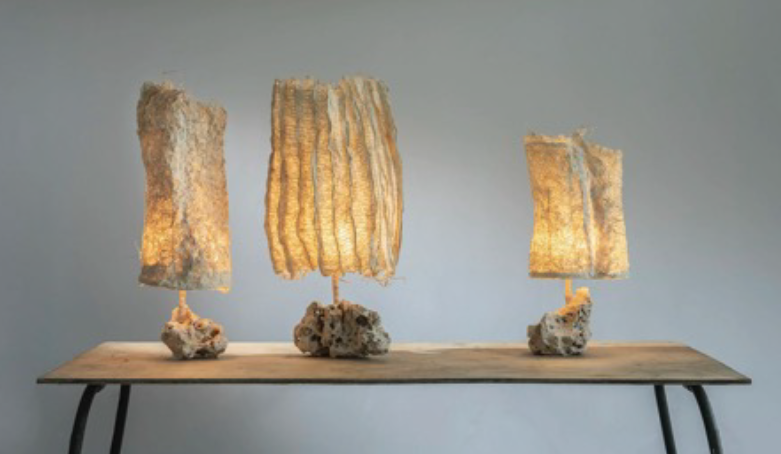
La actividad celular existente en la zona apical de la raíz, en el meristemo y la cofia son posibilidades efectivas para procesos que consideren el crecimiento vegetal como una necesidad de diseño. El cultivo de raíces vegetales, desde la fabricación, se ha materializado en herramientas, utensilios, puentes tejidos, láminas, tapices y volúmenes. Se trata de una práctica con una limitada difusión.
El cultivo como metodología de diseño desde prácticas afectivas de cooperación con raíces vegetales supone una posibilidad técnica, estética, ecológica y política de relevancia dentro del ámbito de las artes visuales y del diseño de producto, industrial y arquitectónico. El objetivo del presente artículo es profundizar en las implicaciones de estas prácticas de diseño.
Estas prácticas suponen un avance revelador para el biodiseño, pero tienen una producción aún limitada. Las escasas fuentes de información y su dispersión pueden suponer una limitación para la comprensión de estas prácticas en su totalidad. La gestión de la distribución radicular vegetal con fines estéticos humanos puede entenderse como una manipulación destacable desde un punto de vista ético.
El afianzamiento del cultivo de tejidos de raíces de plantas supone un punto de interés desde áreas con una concienciación ecológica inclusiva para o con organismos no humanos y sensibles a otras maneras de habitar el planeta.
Descargas
Citas
-Allan, J., Arnardottir, T., Birchall, E., Bridgens, B., Crawford, A., Mackenzie, L., Morrow, R., Ozkan, D. y Rawes, P. (Eds.) (2023). Bioprotopia: Designing the built environment with living organisms. Birkhäuser. https://doi.org/10.1515/9783035625806
-Alpi, A., Amrhein, N., Bertl, A., Blatt, M. R., Blumwald, E., Cervone, F., Dainty, J., De Michelis, M. I., Epstein, E., Galston, A. W., Goldsmith, M. H. M., Hawes, C., Hell, R., Hetherington, A., Hofte, H., Juergens, G., Leaver, C. J., Moroni, A., Murphy, A. y Wagner, R. (2007). Plant neurobiology: No brain, no gain? Trends in Plant Science, 12(4), 135-136. https://doi.org/10.1016/j.tplants.2007.03.002
-Baluška, F., Lev-Yadun, S. y Mancuso, S. (2010). Swarm intelligence in plant roots. Trends in Ecology & Evolution, 25(12), 682-683. https://doi.org/10.1016/j.tree.2010.09.003
-Baluška, F., Mancuso, S., Volkmann, D. y Barlow, P. W. (2009). The «root-brain» hypothesis of Charles and Francis Darwin: Revival after more than 125 years. Plant Signaling & Behavior, 4(12), 1121-1127. https://doi.org/10.4161/psb.4.12.10574
-Baluška, F., Volkmann, D., Hlavajova, A., Mancuso, S. y Barlow, P. W. (2006). Neurobiological View of Plants and Their Body Plan en Communication in plants: Neuronal aspects of plant life (pp. 19-36). Springer.
-Barad, K. (2007). Meeting the Universe Halfway: Quantum Physics and the Entanglement of Matter and Meaning. Duke University Press. https://doi.org/10.2307/j.ctv12101zq
-Barlow, P. W. (2006). Charles Darwin and the Plant Root Apex: Closing a Gap in Living Systems Theory as Applied to Plants en Communication in plants: Neuronal aspects of plant life (pp. 37-52). Springer.
-Bell, F. A. (2023). Biomaterials for More-Than-Human Futures. University of Colorado.
-Bueren, E. T. L. V. y Struik, P. C. (2005). Integrity and Rights of Plants: Ethical Notions in Organic Plant Breeding and Propagation. Journal of Agricultural and Environmental Ethics, 18(5), 479-493. https://doi.org/10.1007/s10806-005-0903-0
-Calvo Garzón, P. y Keijzer, F. (2011). Plants: Adaptive behavior, root-brains, and minimal cognition. Adaptive Behavior, 19(3), 155-171. https://doi.org/10.1177/1059712311409446
-Carrete, I. A., Ghodrat, S., Scherer, D. y Karana, E. (2023). Understanding the effects of root structure on the mechanical behaviour of engineered plant root materials. Materials & Design, 225, 111521. https://doi.org/10.1016/j.matdes.2022.111521
-Chao, S. (2018). In the Shadow of the Palm: Dispersed Ontologies among Marind, West Papua. Cultural Anthropology, 33(4), 621-649. https://doi.org/10.14506/ca33.4.08
-Comisión Europea. Joint Research Centre. (2016). Global soil biodiversity atlas. Publications Office. https://data.europa.eu/doi/10.2788/799182
-Da Cunha, M. C. (2023). Anti-domesticação. Piseagrama, Vegetalidades, 34-45.
-Darwin, C. (1880). The power of movements in plants. John Murray. https://darwin-online.org.uk/content/frameset?itemID=F1325&viewtype=side&pageseq=1
-Despret, V. (2022). Autobiografía de un pulpo y otros relatos de anticipación. CONSONNI.
-Durand, L. (2022). Etnografía vegetal. Sobre el mundo que construimos en colaboración con las plantas. Alteridades, Políticas de justicia y reparación, 32(64), 111-123.
-Groutars, E., Kim, R. y Karana, E. (2024). Designing living artefacts for multispecies interactions: An ecological approach. International Journal of Design, 18(2). https://doi.org/10.57698/V18I2.04
-Gruntman, M., Groß, D., Májeková, M. y Tielbörger, K. (2017). Decision-making in plants under competition. Nature Communications, 8(1), 2235. https://doi.org/10.1038/s41467-017-02147-2
-Haraway, D. (2019). Seguir con el problema: Generar parentesco en el Chthuluceno. Consonni.
-Haraway, D. (con Mellén, I.) (2016). Manifiesto de las especies de compañía. Sans Soleil.
-Hartmann, A., Rothballer, M. y Schmid, M. (2008). Lorenz Hiltner, a pioneer in rhizosphere microbial ecology and soil bacteriology research. Plant and Soil, 312(1-2), 7-14. https://doi.org/10.1007/s11104-007-9514-z
-Hetherington, A. J. (2024). Fossil Evidence Supports at Least Two Origins of Plant Roots en T. Beeckman y A. Eshel, Plant Roots: The Hidden Half (pp. 3-18). CRC Press. https://doi.org/10.1201/b23126
-Hiernaux, Q. (2021). The Ethics of Plant Flourishing and Agricultural Ethics: Theoretical Distinctions and Concrete Recommendations in Light of the Environmental Crisis. Philosophies, 6(4), 91. https://doi.org/10.3390/philosophies6040091
-Latour, B. y Yaneva, A. (2017). «Give Me a Gun and I Will Make All Buildings Move»: An ANT’s View of Architecture. Ardeth, 01(08), 103-111. https://doi.org/10.17454/ARDETH01.08
-Ludwig, F., Middleton, W., Gallenmüller, F., Rogers, P. y Speck, T. (2019). Living bridges using aerial roots of ficus elastica – an interdisciplinary perspective. Scientific Reports, 9(1), 12226. https://doi.org/10.1038/s41598-019-48652-w
-Manti, F. (2015). Towards a new ethics for bioculture. Global Bioethics, 26(3-4), 177-189. https://doi.org/10.1080/11287462.2015.1024947
-Margulis, L. (1990). Words as Battle Cries: Symbiogenesis and the New Field of Endocytobiology. BioScience, 40(9), 673-677. https://doi.org/10.2307/1311435
-Martin, A., Myers, N. y Viseu, A. (2015). The politics of care in technoscience. Social Studies of Science, 45(5), 625-641. https://doi.org/10.1177/0306312715602073
-McNear, J. y David, H. (2013). The Rhizosphere—Roots, Soil and Everything In Between. Nature Education Knowledge, 4(3), 1.
-Millner, M. E. (1932). Natural Grafting in Hedera Helix. New Phytologist, 31(1), 2-25. https://doi.org/10.1111/j.1469-8137.1932.tb07430.x
-Morton, T. (2019). Humanidad: Solidaridad con los no-humanos. Adriana Hidalgo.
-Murphy, J. (2023, 19 de enero). An Architecture of Transscalarity AN in conversation with Andrés Jaque. The Architect’s Newspaper. https://www.archpaper.com/2023/01/an-in-conversation-with-andres-jaque/
-Musacchio, L. R. (2013). Cultivating deep care: Integrating landscape ecological research into the cultural dimension of ecosystem services. Landscape Ecology, 28(6), 1025-1038. https://doi.org/10.1007/s10980-013-9907-8
-Myers, N. (2021, 7 de enero). How to grow liveable worlds: Ten (not-so-easy) steps for life in the Planthroposcene. abc: religion and ethics. https://www.abc.net.au/religion/natasha-myers-how-to-grow-liveable-worlds:-ten-not-so-easy-step/11906548
-Nägeli, C. (con Leitgeb, H. y Schwendener S.) (1858). Beiträge zur wissenschaftlichen Botanik. W. Engelmann. https://doi.org/10.5962/bhl.title.41397
-Novoplansky, A. (2009). Picking battles wisely: Plant behaviour under competition. Plant, Cell & Environment, 32(6), 726-741. https://doi.org/10.1111/j.1365-3040.2009.01979.x
-Nowack, M. K., Vavrdová, T., Pitsili, E., Hirai, R. y Vahldick, H. (2024). The Root Cap en T. Beeckman y A. Eshel, Plant Roots: The Hidden Half (pp. 66-89). CRC Press. https://doi.org/10.1201/b23126
-Pardo de Santayana, M. y Morales, R. (2014). Inventario español de los conocimientos tradicionales relativos a la biodiversidad en M. Laura y Molina (Eds.). Ministerio de Agricultura, Alimentación y Medio Ambiente.
-Pasquero, C. y Poletto, M. (2022). Biodesign in the age of artificial intelligence: Deep green. Routledge.
-Pérez Rigueiro, J. (2019). Materiales Biológicos y Biomateriales. Dextra.
-Pollini, B. y Rognoli, V. (2024). Healing Materialities: Framing Biodesign’s potential for conventional and regenerative sustainability. Research Directions: Biotechnology Design, 2, e21. https://doi.org/10.1017/btd.2024.14
-Puig de la Bellacasa, M. (2017). Matters of care: Speculative ethics in more than human worlds. University of Minnesota Press.
-Puig de la Bellacasa, M. (2023). El espíritu del suelo: Por una comunidad más que humana. Tercero incluido.
-Ratner, B. D. y Zhang, G. (2020). A History of Biomaterials en Biomaterials Science (pp. 21-34). Elsevier. https://doi.org/10.1016/B978-0-12-816137-1.00002-7
-Rodríguez, C. (2021). Biomaterials 101: From organic waste to material gold. https://fablabbcn.org/blog/emergent-ideas/biomaterials-101
-Rodríguez-Alonso, G. y Dubrovsky, J. G. (2024). The Root Apical Meristem. En T. Beeckman y A. Eshel, Plant Roots: The Hidden Half (pp. 33-65). CRC Press. https://doi.org/10.1201/b23126
-Scarpitti, C. y Valsecchi, F. (2023). For a Coexistence with the More-Than-Human: Making Biomaterials from a Philosophical Perspective. Sustainability, 15(6), 5464. https://doi.org/10.3390/su15065464
-Scherer, D. (2015). Interwoven [Gráfico]. https://dianascherer.nl/
-Scherer, D. (con Aloi, G., Fimmano, P. y Huizing, C.) (2023). Interwoven: Exercises in root system domestication. Jap Sam Books.
-Scott, J. C. (2017). Against the grain: A deep history of the earliest states. Yale University Press.
-Sheldrake, M. (2021). Entangled life: How Fungi Make our Worlds, Change our Minds & Shape our Futures. Random House.
-Simard, S. W., Perry, D. A., Jones, M. D., Myrold, D. D., Durall, D. M. y Molina, R. (1997). Net transfer of carbon between ectomycorrhizal tree species in the field. Nature, 388(6642), 579-582. https://doi.org/10.1038/41557
-Simons, E. (2015). Root fields [Audiovisual]. https://www.youtube.com/watch?v=X4MI3SkkUF0
-Sovová, L., Jehlička, P. y Daněk, P. (2021). Growing the Beautiful Anthropocene: Ethics of Care in East European Food Gardens. Sustainability, 13(9), 5193. https://doi.org/10.3390/su13095193
-Taiz, L., Alkon, D., Draguhn, A., Murphy, A., Blatt, M., Hawes, C., Thiel, G. y Robinson, D. G. (2019). Plants Neither Possess nor Require Consciousness. Trends in Plant Science, 24(8), 677-687. https://doi.org/10.1016/j.tplants.2019.05.008
-Wandersee, J. H. y Schussler, E. E. (1999). Preventing Plant Blindness. The American Biology Teacher, 61(2), 82-86. https://doi.org/10.2307/4450624
-Williams, N. y Collet, C. (2021). Biodesign and the Allure of «Grow-made» Textiles: An Interview with Carole Collet. GeoHumanities, 7(1), 345-357. https://doi.org/10.1080/2373566X.2020.1816141
-Zhou, J., Barati, B., Wu, J., Scherer, D. y Karana, E. (2021). Digital biofabrication to realize the potentials of plant roots for product design. Bio-Design and Manufacturing, 4(1), 111-122. https://doi.org/10.1007/s42242-020-00088-2
Publicado
Cómo citar
Número
Sección
Licencia
Derechos de autor 2026 Sergio Cabanyes

Esta obra está bajo una licencia internacional Creative Commons Atribución-CompartirIgual 4.0.